The Sequoia Curve

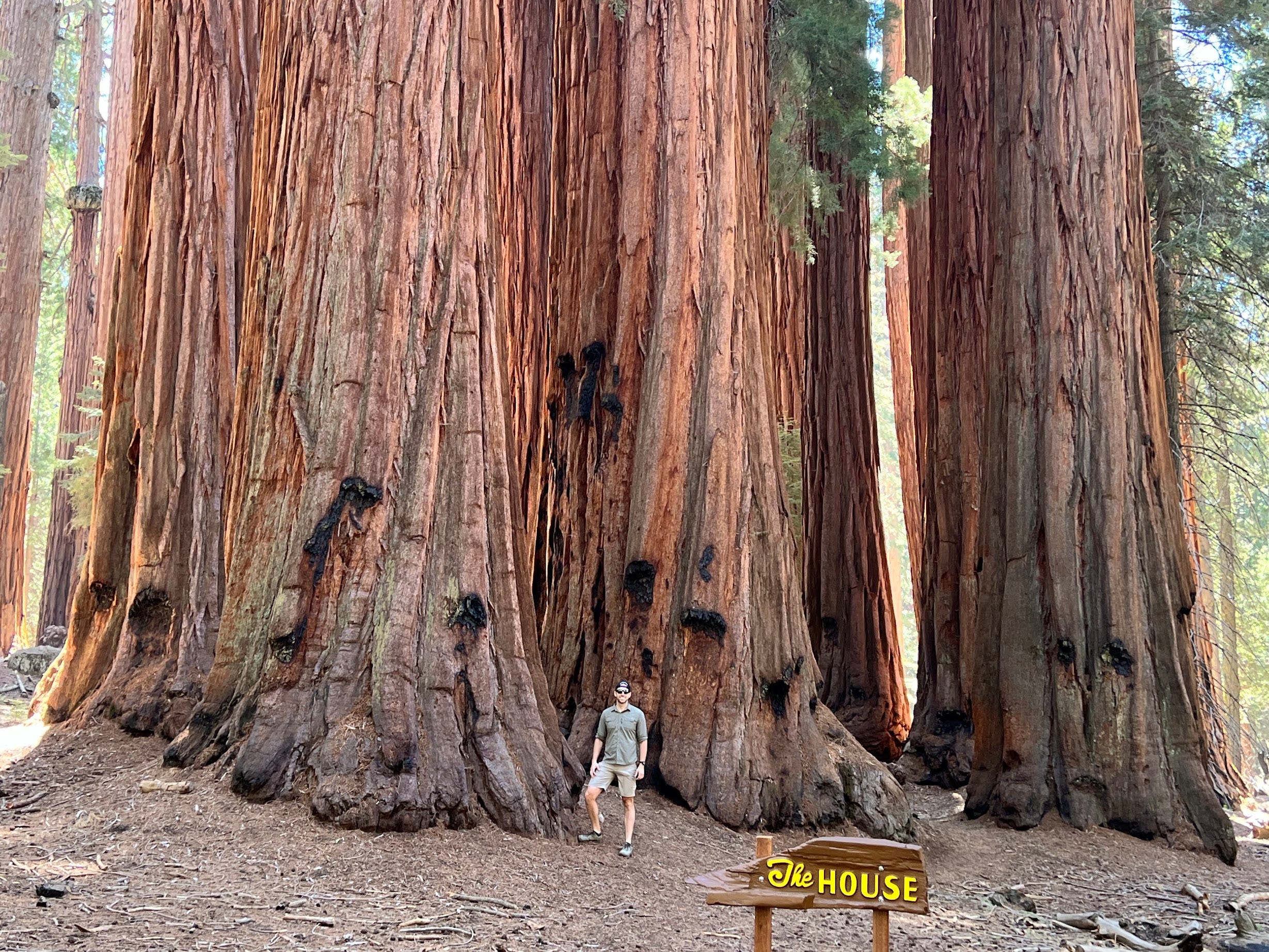
A few years ago I stood in Sequoia and Kings Canyon, looking up at trees that were already old when Rome was young. Everyone looks up at the height. What I kept thinking about was the cone. The largest tree on Earth starts from a cone about the size of a chicken egg, one of thousands the tree carries, each holding a couple hundred seeds. From something that fits in your palm, over three thousand years, you get all of that mass.
I have been waiting for the right moment to write about how these trees grow. This past week gave me one.
A sequoia grows in two distinct motions. For its first few centuries it climbs. In a crowded forest, height wins, and almost everything in the tree’s early life bends toward vertical growth. Then the climbing stops. A sequoia tops out somewhere around 85 to 95 meters. Past that height it cannot pull water any higher against gravity, and the top goes thirsty. So the tree turns its energy sideways and grows wide. The trunk thickens, the base flares, the wood compounds outward for the next two or three thousand years. General Sherman, the largest tree on the planet by volume, earned that title through girth laid down long after it stopped getting taller.
Cone, then height, then width. AI capability is moving along the same arc, and a report out of Anthropic this past week made clear how fast.
The cone and the climb
On June 4th, Anthropic published “When AI Builds Itself.” The numbers are blunt. As of May, more than 80% of the code merged into its own codebase was written by Claude, up from low single digits two years earlier, and a typical engineer now merges about eight times as much code per day as in 2024. The length of task a model can finish on its own is doubling every four months. Two years ago that meant about four minutes of human work; today it is twelve hours. The thing getting better is the thing doing the improving.
But calling this a software story misses where the growth came from. Two levers drive it. Better algorithms buy roughly 3x more capability per unit of compute each year. The compute itself has grown about 4.5x a year, far faster, and mostly through spending: more chips, more data centers, more power. The bigger lever has been spending more rather than thinking smarter, and spending more is the one that runs into walls.
Where the ceiling is
Here is the divergence in one view. The things you can scale with money or cleverness race ahead. The physical pieces crawl.
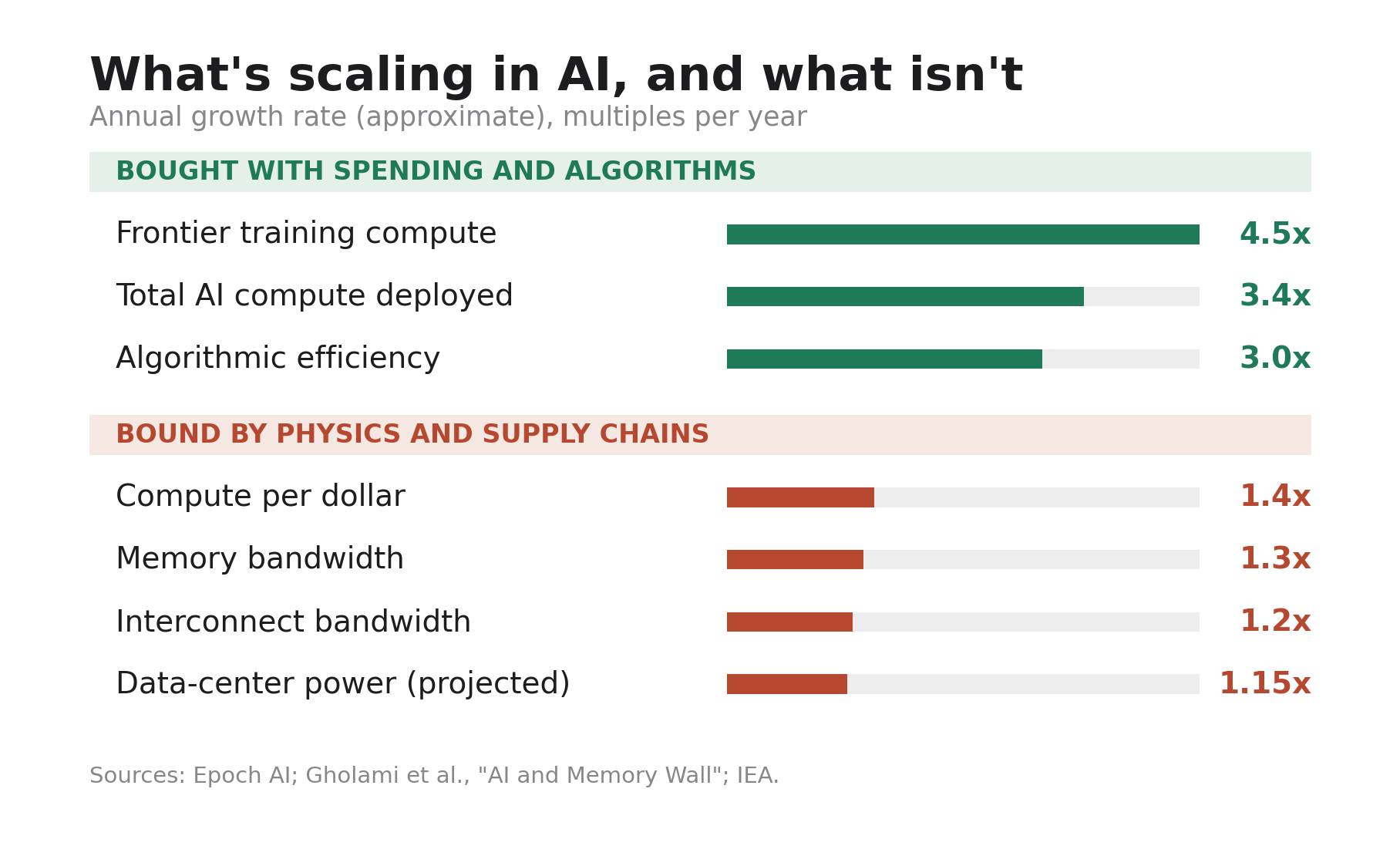
The top three are bought with spending and better algorithms. The bottom four are bound by physics and supply chains. That gap is what I want to talk about.
Over twenty years, raw compute rose around 60,000x while memory bandwidth improved only about 100x. That gap is the memory wall. Much of the time spent running a model goes to waiting for data rather than computing, so piling on more compute buys nothing. Power is the harder limit still, with data-center electricity demand set to more than double by 2030, to around 945 TWh. A model can rewrite its own training loop, but it cannot etch a wafer, stack a memory chip, or add a gigawatt to the grid. The water only goes so high.
The wide years
So far the models have optimized the top of that chart, the parts that were already racing. The turn is what comes next. A system good enough to improve itself keeps going past the algorithm. It hunts for whatever is holding it back, and that is now the bottom of the chart, the memory bandwidth, interconnect, and datacenter power that grow far slower than the compute stacked above them. The same loop that has been rewriting training code gets pointed at those physical bottlenecks and starts wringing out gains nobody chased while the easy ones were still up top: memory that stops starving the chips, links that make a thousand of them act like one, cleaner power per unit of useful work. Physics becomes the next field to optimize once the software is solved. A tree all height and no girth falls over, so the growth moves to the girth.
This is already happening. Google’s AlphaChip designs the floorplans for the last three generations of its AI chips, turning work that once took human teams weeks into a few hours, and it runs as a loop Google’s own people describe plainly: better chip designs train better models, which design better chips. DeepMind’s controllers cut the energy spent cooling Google’s data centers by 40%. And the effort is reaching for power itself. Google’s Project Suncatcher, SpaceX, Starcloud, and Blue Origin are all racing to put data centers in orbit, where a solar panel runs nearly around the clock and makes several times the power it would on the ground, while waste heat radiates off into space. It is early and the economics are unproven. But the direction tells the story. When power is the constraint, the search for more of it leaves the planet.
The value moves with it. When growth was vertical, it went to whoever held the best algorithm, the very advantage recursive self-improvement is now making cheap. When it goes radial, it accrues to whoever owns the scarce physical pieces: chip fabrication and advanced packaging, high-bandwidth memory, lithography, and power. Slow to build, capital-intensive, supply-constrained, and durable for exactly those reasons.
What the cone was for
Hold the sequoia in mind as a whole. A cone you could hold in one hand gives rise to something that climbs for centuries, hits a wall set by physics, and then grows wide for the rest of a very long life. None of the width would exist without the cone, and the cone alone explains none of the mass.
AI grew out of a small idea too, and recursive self-improvement is now driving its vertical phase faster than most people expected. That speed is the reason the wide phase is already coming into view. A sequoia does not become less of a tree when it stops climbing. It becomes the largest living thing in the forest by adding volume, ring by ring, for millennia. The next decade of AI gets built the same way, in chip plants and power stations and the supply chains behind them. The height made the headlines. The width is where I am looking now.
Sources: Anthropic, “When AI Builds Itself” (June 2026); Epoch AI, Trends dashboard; Google DeepMind (AlphaChip; data-center cooling); IEA, Energy and AI; Bain & Company, US Data Center Model; Gholami et al., “AI and Memory Wall.”